


No, we're not talking tits 
Knocker uppers: Waking up the workers in industrial Britain

As the clocks go forward for the start of British Summer Time, many of us will rue the loss of an hour in bed. But how did people get to work on time before alarm clocks?
Until the 1970s in some areas, many workers were woken by the sound of a tap at their bedroom window. On the street outside, walking to their next customer's house, would be a figure wielding a long stick.
Mary Smith charged sixpence a week to wake her clients in east London and woke them up with a bean and blowgun.
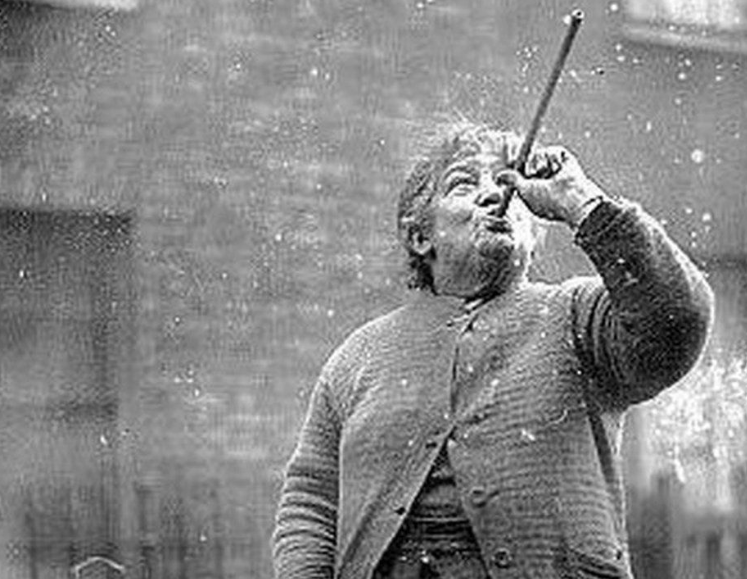
The "knocker upper" was a common sight in Britain, particularly in the northern mill towns, where people worked shifts, or in London where dockers kept unusual hours, ruled as they were by the inconstant tides.
"They used to come down the street with their big, long poles," remembers Paul Stafford, a 59-year-old artist who was raised above a shop in Oldham.
"I would sleep with my brother in the back room upstairs and my parents slept in the front.
"[The knocker upper] wouldn't hang around either, just three or four taps and then he'd be off. We never heard it in the back, though it used to wake my father in the front."
While the standard implement was a long fishing rod-like stick, other methods were employed, such as soft hammers, rattles and even pea shooters.
But who woke the knocker uppers? A tongue-twister from the time tackled this conundrum:
We had a knocker-up, and our knocker-up had a knocker-up
And our knocker-up's knocker-up didn't knock our knocker up
So our knocker-up didn't knock us up
'Cos he's not up.
"The knocker uppers were night owls and slept during the day instead, waking at about four in the afternoon," says author Richard Jones.
One problem knocker uppers faced was making sure workers did not get woken up for free.
"When knocking up began to be a regular trade, we used to rap or ring at the doors of our customers," Mrs Waters, a knocker upper in the north of England told an intrigued reporter from Canada's Huron Expositor newspaper in 1878.
"The public complained of being disturbed... by our loud rapping or ringing; and the knocker-up soon found out that while he knocked up one who paid him, he knocked up several on each side who did not," she continued.
The solution they hit on was modifying a long stick, with which to tap on the bedrooms windows of their clients, loudly enough to rouse those intended but softly enough not to disturb the rest.
The trade spread rapidly across the country, particularly in areas where poorly paid workers were required to work shifts but could not afford their own watches.
Charles Dickens references knocking up in Great Expectations and it also features in the story of the Jack the Ripper murders in east London.
 www.bbc.com
Knocker uppers: Waking up the workers in industrial Britain
As the clocks go forward for the start of British Summer Time, many of us will rue the loss of an hour in bed. But how did people get to work on time before alarm clocks?
Until the 1970s in some areas, many workers were woken by the sound of a tap at their bedroom window. On the street outside, walking to their next customer's house, would be a figure wielding a long stick.
Mary Smith charged sixpence a week to wake her clients in east London and woke them up with a bean and blowgun.
The "knocker upper" was a common sight in Britain, particularly in the northern mill towns, where people worked shifts, or in London where dockers kept unusual hours, ruled as they were by the inconstant tides.
"They used to come down the street with their big, long poles," remembers Paul Stafford, a 59-year-old artist who was raised above a shop in Oldham.
"I would sleep with my brother in the back room upstairs and my parents slept in the front.
"[The knocker upper] wouldn't hang around either, just three or four taps and then he'd be off. We never heard it in the back, though it used to wake my father in the front."
While the standard implement was a long fishing rod-like stick, other methods were employed, such as soft hammers, rattles and even pea shooters.
But who woke the knocker uppers? A tongue-twister from the time tackled this conundrum:
We had a knocker-up, and our knocker-up had a knocker-up
And our knocker-up's knocker-up didn't knock our knocker up
So our knocker-up didn't knock us up
'Cos he's not up.
"The knocker uppers were night owls and slept during the day instead, waking at about four in the afternoon," says author Richard Jones.
One problem knocker uppers faced was making sure workers did not get woken up for free.
"When knocking up began to be a regular trade, we used to rap or ring at the doors of our customers," Mrs Waters, a knocker upper in the north of England told an intrigued reporter from Canada's Huron Expositor newspaper in 1878.
"The public complained of being disturbed... by our loud rapping or ringing; and the knocker-up soon found out that while he knocked up one who paid him, he knocked up several on each side who did not," she continued.
The solution they hit on was modifying a long stick, with which to tap on the bedrooms windows of their clients, loudly enough to rouse those intended but softly enough not to disturb the rest.
The trade spread rapidly across the country, particularly in areas where poorly paid workers were required to work shifts but could not afford their own watches.
Charles Dickens references knocking up in Great Expectations and it also features in the story of the Jack the Ripper murders in east London.
Knocker uppers: Waking up the workers in industrial Britain
As the clocks go forward for the start of British Summer Time, many of us will rue the loss of an hour in bed. But how did people get to work on time before alarm clocks?
www.bbc.com

