Stock compounding effect

Big Rig

Well-known member
May 6, 2009
2,199
340
83
If a stock rose 10% in a year did you make more than 10%?

What about compound return? Does that mean you made more than 10%?
or does the stock price relect compounding ?

For example, if a stock rose 10% each day for 2 days then the stock rose 10% of the first days 10%
so it compounded itself just like investment money would
and rose more on the second day

Stock was $1 times 1.1 times 1.1 so after two days it is worth $1.21
 
Last edited:

Scopez

Well-known member
Aug 22, 2018
294
474
63
The power of compounding.

Time in the market > timing the market is the best way to understand.

The stock market is just a reflection of the consumer market. Look at everyday products/ businesses you use and zoom out their gains from 5 years ago.


If they are a successful business, the market will reflect that and their business gains will compound.
Inflation, institutions, and globalist governments help aswell.


Bad businesses have the inverse compound effect. Those ones fall "bigly".
 

Ponderling

Lotsa things to think about
Jul 19, 2021
1,871
1,583
113
Mississauga
Stock prices bop around all the time.
If you are set up to reinvest dividends, then yes, there can be componding.

I ususally use the cash from divvys to buy more shares of stocks that to me look a little short term beat up.
But appear to me to still have good longer term prospects.

I do this about 2x a year.
More often than that might work better, but me not dinking with the holdings too often is probably more profitable.

Best out of favour story for me was FM- First Quantum Minerals.
About a decade ago China economy has slipped into a modest recession, so global metals demand dropped some
So FM missed analysts forecasts of earnings for the quarter.
The stock had been trading 5-6 range. It was down to 2.10.
Wife's TFSA funds for the year went in and bought at 2.25.

Over next 18 months we sold off the gains at prices between 14 and 18 a share.

PKI Parkland Fuels had bought a refinery fro Chevron to be more vertically oriented.
There were modernization cost on the acquisition, so PKI missed anaylists foreasts for a quarter.
Price sagged about 25%. I loaded up and waited about 9 months for the price to float north of 40% over the pre sag price as the refinery came on line and their input costs were overcome.

If you really want you eyes openned about investing opportunities, read the Sleuth Investor by Avner Mandelman.
 
  • Like
Reactions: Smallguy

Mencken

Well-known member
Oct 24, 2005
1,064
52
48
If a stock rose 10% in a year did you make more than 10%?

What about compound return? Does that mean you made more than 10%?
or does the stock price relect compounding ?

For example, if a stock rose 10% each day for 2 days then the stock rose 10% of the first days 10%
so it compounded itself just like investment money would
and rose more on the second day

Stock was $1 times 1.1 times 1.1 so after two days it is worth $1.21
Nope. What happens each day is irrelevant. The change over the period of time, say the year that you are interested in knowing the return for, is just a simple calculation. Now if you are considering including dividends then the total return would be higher, and if you re-invested the dividends it is sort of like compound return, but even then if you take the end value (which would include reinvested dividends) over the start value it will show you the real return no matter how it got there.
 

yyzdeltatango

Member
Jan 13, 2017
17
4
18
If a stock rose 10% in a year did you make more than 10%?

What about compound return? Does that mean you made more than 10%?
or does the stock price relect compounding ?

For example, if a stock rose 10% each day for 2 days then the stock rose 10% of the first days 10%
so it compounded itself just like investment money would
and rose more on the second day

Stock was $1 times 1.1 times 1.1 so after two days it is worth $1.21
Stock price changes are always relative to something. If the "year to date" is 10%, then it's up 10% on the year and there is no compounding to add to the figure. If you bought on January 1st, and it closed December 31st up 10% for the year, your investment is up 10% assuming you never invested any extra (including any dividend it might have paid out).

When you look at the stock ticker on the news, and it says a certain stock is up 10% without specifying the time frame, that's almost always in reference to previous market close. So if they say on Tuesday that a stock is "up 10%", they mean it's currently 10% higher than it was when the market closed on Monday.

So if the evening news says on Tuesday that it's up 10%, and then in Wednesday they say it's up 10% again, that means it went up 10% between close on Monday and close on Tuesday, and up another 10% between close on Tuesday and close on Wednesday. So yes, it would be up 21% over the 2 days because of compounding.

But if on Wednesday they say it's up 20% from Monday's close, then that already factors it in and it's only up 20%.

So being "up" or "down" is relative to some point in time. If you're looking at a 6 month chart and it says up 3%, that means in 6 months it's gone up 3%, not 3% plus compounding. So if it was $100/share 6 months ago, it's $103/share.

As for "did you make", that depends on if you sold. If you bought 100 shares of a stock on January 1st worth $100/share, you spent $10,000 and got shares in return. If on December 31st the stock is worth $110/share (up 10% on the year), you haven't made anything yet. Your investment portfolio is up 10%, so the stock you paid $10,000 is now worth $11,000, but you haven't made anything until you sell it. If you sell it at that price, you'll get back your initial $10,000 investment, and get $1,000 profit (assuming no fees/taxes).
 
  • Like
Reactions: superstar_88

Big Rig

Well-known member
May 6, 2009
2,199
340
83
So if the evening news says on Tuesday that it's up 10%, and then in Wednesday they say it's up 10% again, that means it went up 10% between close on Monday and close on Tuesday, and up another 10% between close on Tuesday and close on Wednesday. So yes, it would be up 21% over the 2 days because of compounding.

But if on Wednesday they say it's up 20% from Monday's close, then that already factors it in and it's only up 20%.
You seem to understand my question but I am still confused.

So, if they say market is up 20% on Wednesday that means it did not rise 10% each day because they would have said 21% if it had ?
 
Last edited:

yyzdeltatango

Member
Jan 13, 2017
17
4
18
You seem to understand my question but I am still confused.

So, if they say market is up 20% on Wednesday that means it did not rise 10% each day because they would have said 21% if it had ?
If they say "It's up 20%," it's always 20% relative to whatever time they are comparing it to. If it was 21%, they'd say that.

It sounds like you're asking if, on Wednesday, they'd see it went up 10% Monday, 10% Tuesday, and then add those together. They wouldn't. They'd look at the current value, then look at some past value they want to compare to, and calculate.

If market closed Friday with the stock worth $100, and on Monday close it was worth $110, but then on Tuesday close it was worth $121, at market open on Wednesday, they would never say it's up 20% so far on the week even if it is 2 days of consecutive 10% increases. They'd say it's up 21%, because that's the comparison of $121 to $100. They wouldn't do $121 compared to $110 and $110 compared to $100 and add the results; they'd just go straight to comparing $121 to $100.

They will always report by calculating from the values they are comparing, not by adding percentages, because adding percentages is both inaccurate and of no value to anyone.
 
Last edited:

Zoot Allures

Well-known member
Jan 23, 2017
2,570
1,182
113
If they say "It's up 20%," it's always 20% relative to whatever time they are comparing it to. If it was 21%, they'd say that.

It sounds like you're asking if, on Wednesday, they'd see it went up 10% Monday, 10% Tuesday, and then add those together. They wouldn't. They'd look at the current value, then look at some past value they want to compare to, and calculate.

If market closed Friday with the stock worth $100, and on Monday close it was worth $110, but then on Tuesday close it was worth $121, at market open on Wednesday, they would never say it's up 20% so far on the week even if it is 2 days of consecutive 10% increases. They'd say it's up 21%, because that's the comparison of $121 to $100. They wouldn't do $121 compared to $110 and $110 compared to $100 and add the results; they'd just go straight to comparing $121 to $100.

They will always report by calculating from the values they are comparing, not by adding percentages, because adding percentages is both inaccurate and of no value to anyone.

I agree with deltatango

Big Rig, you are overthinking this. It is simple.

The S&P500 for example, all indexes work the same,
has 500 stocks they follow that represents the market all as whole. When one stock no longer matches the criteria of the 500 they drop it and choose another. At any given time throughout the day
they average the gain or loss of those 500 stocks in terms of percentage that is was before the stock market opened.

Thr next day they do the exact same thing

You seem to be comparing the magic of compounding interest with the magic of stock prices rising.
They are not the same animal .

Over the long term the magic of the market will beat the magic of any interest rate you can get, it is not even close

The answer to your question is the stock prices do incorporate compounding

Stock broker salesmen have a very misleading poster that truefully graphs the rise of the market since 1930. $100 invested then would be worth over $1,300,000 today because the market averages 11.5% gain every year since 1930. This is true but very misleading because you bought the stock at its lowest point IE the great depression and when you bought it means everything. The rise of the market is irrelevant, the rise since you bought it is what counts.

Bad investors panic when the market falls and sell then buy when it rises. IE they sell low and buy high which is the opposite of what you should do.

As market timing is impossible you should just buy and hold.

Since 1960 the S&P has risen 6.5 % annually, on average, and that is what you should reasonably expect not the 11.5% rise since the great depression when the market was at a historic low


Because we realize the annual rate the market rose in retrospect, we have to compound that rate like a interest rate to see what the value would be if we had invested. We do not have to use the rise every single day just the annualized return, I think, but I not sure I am correct. The answer to the question I just asked seems to be what is confusing you and it is an interesting question
 
Last edited:

yyzdeltatango

Member
Jan 13, 2017
17
4
18
Since 1960 the S&P has risen 6.5 % annually, on average, and that is what you should reasonably expect not the 11.5% rise since the great depression when the market was at a historic low
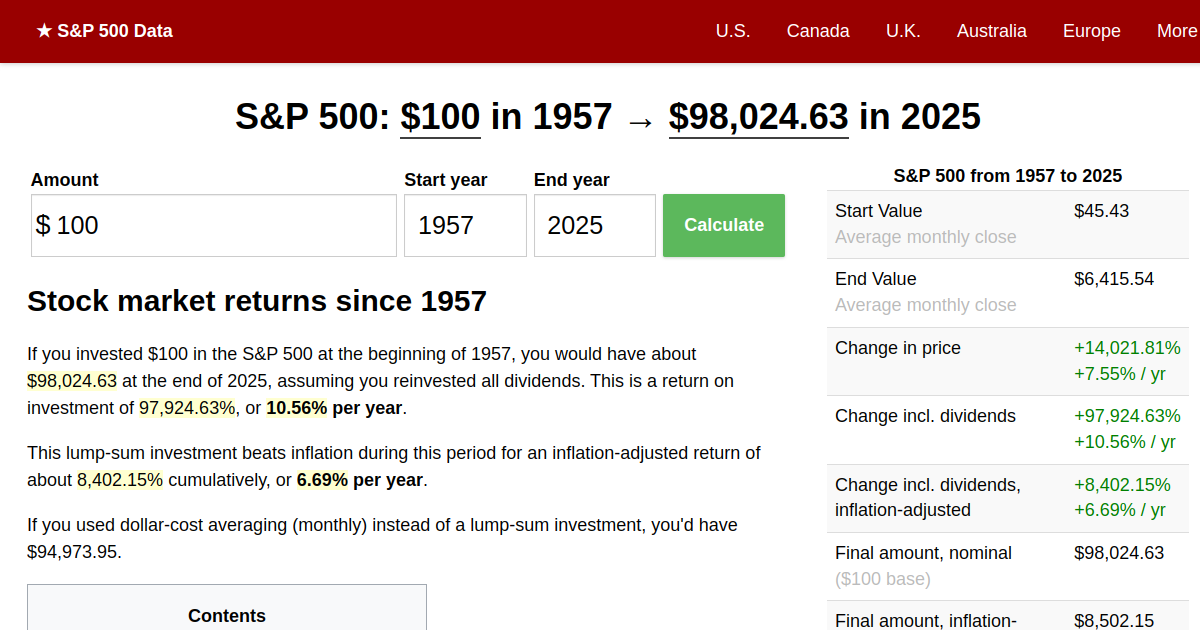
Since 1960 the average is 10.23%. I think you're adjusting for inflation, which is apples to oranges, and that's 6.28%. If you're saying starting in 1926 overinflates the value, I disagree. Since 1926 (the usual date used to start the calculations), the average is 10.22%, which is roughly the same, and inflation adjusted is only a touch higher, at 7.05%. Using your 1930 year specifically, it's even lower: 9.84% and 6.49%.

You can play with the data yourself to check:


In any case, since we can't really know what inflation will do, I usually assume a 10% per year unadjusted, 7% adjusted, when forecasting with the S&P500. So far my own personal returns have far exceeded that.
 

Zoot Allures

Well-known member
Jan 23, 2017
2,570
1,182
113
Since 1960 the average is 10.23%. I think you're adjusting for inflation, which is apples to oranges, and that's 6.28%. If you're saying starting in 1926 overinflates the value, I disagree. Since 1926 (the usual date used to start the calculations), the average is 10.22%, which is roughly the same, and inflation adjusted is only a touch higher, at 7.05%. Using your 1930 year specifically, it's even lower: 9.84% and 6.49%.

You can play with the data yourself to check:


In any case, since we can't really know what inflation will do, I usually assume a 10% per year unadjusted, 7% adjusted, when forecasting with the S&P500. So far my own personal returns have far exceeded that.

Thankyou for the correction. Great to know.
As far as you exceeding that number, I do believe returns over last 10 years have been exceptional.

What is also interesting is


If you used dollar-cost averaging (monthly) instead of a lump-sum investment, you'd have $79,370
instead of $81,8919. Not much difference.
The logic of dollar cost averaging escaped me as I figured it was just a gimmick by banks to get you to buy their mutual funds. The numbers show it is, but I am surprised at the little difference. I would have thought the difference would have been bigger.

If you got some money to invest just throw it all in as the odds are with you
 
Toronto Escorts